Keywords are the foundation of SEO, but many business owners still ask the same question. How many keywords are enough? Some people believe every page should target dozens of keywords. Others think one keyword is enough for a complete SEO strategy. The truth sits somewhere in the middle. A good SEO strategy is not about adding as many keywords as possible. It is about choosing the right keywords, placing them naturally, and matching the search intent behind them. In this guide, you will learn how many keywords to use on a page, how to avoid keyword stuffing, and how to build a keyword strategy that supports rankings, traffic, and conversions.
What Are Keywords in SEO?
Keywords are the words and phrases people type into search engines when looking for information, products, or services.
For example, someone may search for:
- Best SEO agency
- Website development services
- Local SEO checklist
- How many keywords should I use
- SEO keyword strategy for small business
These search terms help Google understand what users want. They also help website owners create content that answers those needs.
However, keywords are not just random words. They represent user intent. This means every keyword shows what someone wants to learn, compare, buy, or solve.
That is why keyword research is important. It helps you understand your audience before you write content.
How Many Keywords Should a Blog Post Target?
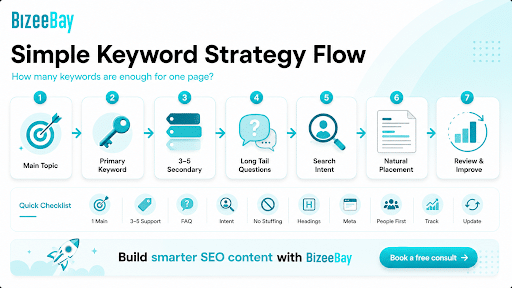
A normal blog post should usually target one primary keyword and three to five secondary keywords. It can also include several related long-tail keywords naturally.
This structure keeps the blog focused while still helping it rank for multiple search queries.
A simple keyword structure looks like this:
|
Keyword Type |
Recommended Count |
Purpose |
|
Primary keyword |
1 |
Main topic of the page |
|
Secondary keywords |
3 to 5 |
Support the main topic |
|
Long tail keywords |
5 to 10 |
Capture specific searches |
|
Semantic keywords |
10 or more |
Add topic depth and context |
For example, if your blog title is Keywords: How Many is Enough?, your keyword plan may look like this:
|
Keyword Role |
Example Keyword |
|
Primary keyword |
how many keywords are enough |
|
Secondary keyword |
how many keywords should I use |
|
Secondary keyword |
SEO keyword strategy |
|
Secondary keyword |
keyword density |
|
Secondary keyword |
keyword stuffing |
|
Long tail keyword |
how many keywords should a blog post have |
|
Long tail keyword |
how many keywords per page for SEO |
|
Semantic keyword |
search intent, keyword research, on-page SEO |
This gives your blog a clear focus without making it repetitive.
Why One Primary Keyword Is Usually Enough
Every SEO page should have one main topic. That topic should be represented by one primary keyword.
The primary keyword helps guide the title, headings, introduction, URL, and overall content direction. If you try to target too many main keywords on one page, the content becomes confusing.
For example, one blog should not try to rank equally for:
- Keyword research
- Technical SEO
- Local SEO
- Link building
- Website speed
These topics are all related to SEO, but each one deserves its own dedicated page or blog post.
When you choose one primary keyword, your article becomes more focused. As a result, readers understand the topic quickly, and search engines can classify the page more easily.
What Are Secondary Keywords?
Secondary keywords are closely related phrases that support the primary keyword. They help your content cover the topic more completely.
For example, if your primary keyword is how many keywords are enough, your secondary keywords may include:
- how many keywords should I use
- how many keywords per page
- keyword density
- SEO keyword strategy
- keyword placement
These keywords should not feel forced. They should appear naturally in headings, paragraphs, bullet points, and FAQs.
Secondary keywords are useful because people search for the same topic in different ways. By including these variations, your blog can rank for more relevant searches.
What Are Long Tail Keywords?
Long tail keywords are longer and more specific search phrases. They usually have lower search volume, but they often have stronger intent.
For example:
- how many keywords should a blog post have
- how many keywords should I use for SEO
- how many keywords per page is good for rankings
- how to use keywords without keyword stuffing
These phrases are valuable because they match real questions from users. They are also easier to use in blog headings and FAQ sections.
Long tail keywords often bring better quality traffic because the searcher knows exactly what they want.
Keyword Density: Does It Still Matter?
Keyword density means how often a keyword appears compared to the total word count. In older SEO practices, people tried to hit a fixed keyword percentage.
Today, keyword density is less important than natural usage and search intent.
A keyword should appear enough times for the topic to be clear, but not so much that the writing sounds robotic.
A safe approach is to use the primary keyword in:
- SEO title
- Meta description
- First 100 words
- One H2 or H3 heading
- A few natural paragraphs
- Conclusion
- One FAQ answer if relevant
Do not repeat the same phrase in every paragraph. Google is now better at understanding related words, synonyms, and context.
What Is Keyword Stuffing?
Keyword stuffing happens when a writer unnaturally repeats keywords too many times. It makes the content hard to read and can damage SEO performance.
Here is an example of keyword stuffing:
“Keywords are important keywords because keywords help your keyword strategy rank for keywords.”
This sentence is unpleasant and unhelpful. It does not create value for the reader.
A better version would be:
“Keywords help search engines understand your content, but they should always be used naturally.”
Good SEO writing should sound helpful, not forced.
Where Should You Place Keywords?
Keyword placement matters more than keyword repetition. A well-placed keyword can send a stronger signal than repeated usage.
Use your main keyword in important locations.
Best places to use keywords
|
Page Element |
Keyword Use |
|
SEO title |
Add the primary keyword |
|
Meta description |
Use the primary or a close variation |
|
H1 heading |
Include the main keyword or title phrase |
|
Introduction |
Mention the topic clearly |
|
H2 headings |
Use secondary keywords naturally |
|
Body content |
Add keywords where they fit |
|
Image alt text |
Describe the image with relevant terms |
|
URL slug |
Keep it short and keyword-focused |
|
FAQ section |
Use question-based keywords |
This structure helps readers and search engines understand the page clearly.
How Many Keywords Are Enough for a Service Page?
A service page usually needs fewer keywords than a long blog post. It should focus on one main service and a few supporting terms.
For example, a page about SEO services may target:
- SEO services
- SEO agency
- SEO audit services
- local SEO services
- technical SEO services
The page should explain the service clearly, show benefits, answer objections, and guide visitors toward contacting the business.
A service page should not become a keyword list. It should feel like a helpful sales page with strong SEO structure.
How Many Keywords Are Enough for a Homepage?
A homepage should not target every service keyword. It should focus on the brand, main offering, and broad business category.
For example, a digital marketing company homepage may target:
- SEO agency
- digital marketing agency
- website development services
- LLMO services
- AI search optimization
However, each main service should still have its own dedicated page. This makes the website easier to understand and improves ranking opportunities.
Common Keyword Mistakes to Avoid
Many websites struggle with SEO because they use keywords incorrectly. The issue is often not the number of keywords, but the strategy behind them.
Avoid these mistakes:
- Targeting too many primary keywords on one page
- Repeating the same keyword unnaturally
- Ignoring search intent
- Using keywords that do not match the offer
- Writing thin content around high-value keywords
- Forgetting long tail keywords
- Using the same keyword on many pages
- Ignoring internal linking
- Not updating old content
A strong keyword strategy is organized. Every page should have a clear purpose and a defined search target.
So, How Many Keywords Are Enough?
For most blog posts, one primary keyword, three to five secondary keywords, and several long-tail keywords are enough.
For service pages, one primary keyword and two to four supporting keywords are usually enough.
For homepages, focus on brand positioning and your main service categories.
The goal is not to use more keywords. The goal is to use the right keywords with useful content, clear structure, and strong search intent.
When your content answers the user’s question better than competing pages, keywords become much more powerful.
Ready to Build a Smarter Keyword Strategy?
Keywords still matter, but they work best when used with strategy, structure, and helpful content.
At BizeeBay, we help businesses create SEO strategies that attract traffic, improve rankings, and turn visitors into leads. Our team can help with keyword research, SEO audits, content planning, technical SEO, and AI search optimization.
Want to know which keywords your website should target next?
Explore BizeeBay SEO services: https://bizeebay.com/services/bizeebay-seo/
Read more SEO insights: https://bizeebay.com/blog/
Book a free consultation: https://bizeebay.com/contact-us/
Use the right keywords, create better content, and let your website work harder for your business.
Frequently Asked Questions
How many keywords should I use in a blog post?
A blog post should usually use one primary keyword, three to five secondary keywords, and several long-tail keywords.
Can I use too many keywords?
Yes. Using too many keywords can make your content unclear and unnatural. It can also lead to keyword stuffing.
What is the ideal keyword density?
There is no perfect keyword density. Use keywords naturally and focus on search intent, readability, and helpful content.
Should every page target a different keyword?
Yes. Each important page should target a unique keyword or topic to avoid competing with your own content.
Are long tail keywords important?
Yes. Long tail keywords help you answer specific questions and attract users with clearer search intent.