Search engine optimization (SEO) is all about helping search engines understand your content while providing a great experience for users. However, not every SEO tactic follows search engine guidelines.
One of the most deceptive practices in SEO is cloaking.
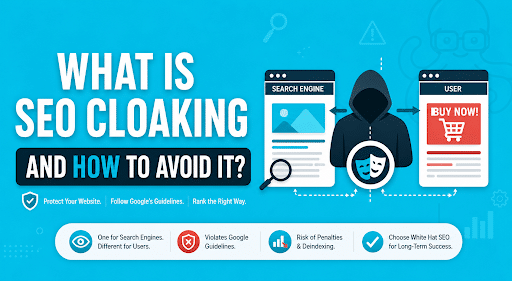
SEO cloaking involves showing one version of a webpage to search engines while displaying different content to users. Although some website owners attempt to use cloaking to manipulate rankings, it violates Google’s Search Essentials and can result in severe penalties, including lower rankings or complete removal from search results.
In this guide, you’ll learn what SEO cloaking is, how it works, why it’s considered a black-hat SEO technique, and how to avoid it when building a sustainable SEO strategy.
What Is SEO Cloaking?
SEO cloaking is the practice of presenting different content or URLs to search engines than what visitors actually see.
For example:
- Googlebot visits a page and sees an article optimized for “best SEO agency.”
- A real visitor clicks the same result but lands on an unrelated sales page or promotional offer.
Because the content shown to search engines differs from what users receive, this technique is considered deceptive and violates Google’s spam policies.
Why Is SEO Cloaking Against Google's Guidelines?
Google’s goal is to deliver accurate, relevant search results.
When websites display different content to search engines than users, it creates a poor search experience and manipulates rankings unfairly.
Google specifically lists cloaking as a spam practice because it attempts to deceive both users and search engines.
Websites caught using cloaking may experience:
- Significant ranking drops
- Manual actions
- Deindexing from Google
- Loss of organic traffic
- Reduced trust and authority
How Does SEO Cloaking Work?
Cloaking typically detects who’s visiting the website before deciding which version of the page to display.
The website may identify visitors by:
- User-agent detection
- IP address detection
- HTTP headers
- JavaScript behavior
- Browser information
If the visitor is recognized as Googlebot, the website displays one version.
If it’s a human visitor, an entirely different version appears.
Common Types of SEO Cloaking
User-Agent Cloaking
The website checks whether the visitor is Googlebot or another search engine crawler.
If detected, it serves optimized content specifically designed for search engines.
Everyone else receives different content.
IP-Based Cloaking
Certain IP addresses belonging to search engines receive different webpages than regular users.
This is one of the oldest cloaking methods.
JavaScript Cloaking
Some websites hide or replace content after the page loads using JavaScript.
Although JavaScript itself isn’t bad, using it to intentionally deceive search engines can become cloaking.
Hidden Content Cloaking
A page may contain keyword-rich content visible only to search engines while hiding it from visitors.
Examples include:
- Invisible text
- CSS-hidden paragraphs
- Hidden keyword blocks
Redirect Cloaking
Visitors may click one page in search results but immediately get redirected somewhere entirely different.
This creates a misleading user experience
Examples of SEO Cloaking
Example 1
Google sees:
“Affordable SEO Services for Small Businesses”
Users see:
Online casino advertisements.
Example 2
Search engines see:
A detailed product review.
Users see:
An affiliate landing page with no review.
Example 3
Google indexes:
A local business website.
Visitors land on:
A completely unrelated promotional website.
Is Cloaking Ever Acceptable?
Generally, no.
However, some practices are often confused with cloaking but are legitimate.
Examples include:
- Responsive website design
- Language-based content
- Country-specific versions
- Accessibility improvements
- Dynamic content personalization
As long as search engines and users receive substantially the same content, these practices do not violate Google’s guidelines.
Cloaking vs. Dynamic Content
Many websites personalize content based on location or user preferences.
For example:
A visitor in Texas sees:
“Serving Dallas Businesses”
A visitor in Florida sees:
“Serving Miami Businesses”
This isn’t cloaking if search engines receive the same version users would receive from that location.
The key difference is transparency, not deception.
Why Some Websites Still Use Cloaking
Despite the risks, some websites attempt cloaking to:
- Manipulate rankings
- Stuff keywords
- Hide spam pages
- Promote unrelated products
- Display misleading affiliate offers
- Avoid search engine guidelines
While these tactics may create short-term gains, they almost always result in long-term losses.
Risks of SEO Cloaking
Using cloaking can seriously damage your website’s performance.
Potential consequences include:
Google Penalties
Manual actions can remove pages or entire websites from Google’s index.
Loss of Rankings
Even without a manual penalty, algorithm updates often detect deceptive practices.
Reduced Trust
Visitors lose confidence when the page they expected differs from what they receive.
Revenue Loss
Lower rankings lead to fewer visitors, fewer leads, and reduced sales.
How to Avoid SEO Cloaking
Following white hat SEO practices is the safest way to build long-term visibility.
Show the Same Content to Everyone
Search engines and visitors should receive the same page.
Follow Google's Search Essentials
Build content for people, not algorithms.
Focus on Helpful Content
Answer user questions with valuable, original information.
Avoid Hidden Text
Don’t hide keywords using CSS, tiny fonts, or matching background colors.
Use Proper Redirects
Only redirect users when there’s a legitimate reason, such as:
- HTTPS migrations
- Website redesigns
- Deleted pages
- Updated URLs
Always use permanent (301) redirects where appropriate.
Perform Regular SEO Audits
Routine technical SEO audits help identify:
- Hidden content
- Redirect problems
- Crawl issues
- Duplicate pages
- Indexing errors
White Hat SEO vs. Black Hat SEO
|
White Hat SEO |
Black Hat SEO |
|
Helpful content |
Cloaking |
|
Technical SEO |
Hidden text |
|
Keyword research |
Keyword stuffing |
|
Quality backlinks |
Link schemes |
|
User-focused optimization |
Doorway pages |
|
Long-term growth |
Short-term manipulation |
White hat SEO creates sustainable growth, while black hat techniques put your website at risk.
How BizeeBay Helps Businesses Build Sustainable SEO
At BizeeBay, we believe successful SEO should be built on transparency, technical excellence, and long-term results.
Our SEO specialists help businesses improve search visibility through:
- Technical SEO
- Keyword Research
- On-Page SEO
- Local SEO
- Content Strategy
- Website Audits
- Schema Markup
- Internal Linking
- Performance Optimization
Rather than relying on risky shortcuts, we implement ethical SEO strategies that strengthen your website’s authority and deliver measurable growth over time.
If you’re looking to improve your rankings the right way, explore our SEO Services and discover how our team can help your business achieve sustainable online success.
Build Long-Term SEO Success Without Risk
SEO cloaking may promise quick ranking improvements, but the risks far outweigh any short-term gains. Search engines are continually improving their ability to detect deceptive practices, making sustainable, ethical SEO the only reliable path to long-term success.
By focusing on high-quality content, technical SEO, user experience, and transparency, you can build a website that earns trust from both search engines and your audience. Following white hat SEO best practices not only protects your website from penalties but also creates a stronger foundation for lasting organic growth.
If your goal is to improve search rankings and attract qualified traffic, invest in strategies that prioritize users first. Ethical SEO delivers results that stand the test of time, and that’s exactly the approach BizeeBay helps businesses achieve every day.
Frequently Asked Questions
What is SEO cloaking?
SEO cloaking is a black hat SEO technique that displays different content to search engines than to users in an attempt to manipulate search rankings.
Is SEO cloaking illegal?
SEO cloaking isn’t illegal, but it violates Google’s Search Essentials and can result in manual penalties or removal from search results.
Does Google detect cloaking?
Yes. Google uses advanced algorithms, spam detection systems, and manual reviewers to identify deceptive practices, including cloaking.
Is cloaking considered black hat SEO?
Yes. Cloaking is one of the most well-known black hat SEO techniques because it intentionally deceives search engines and users.
What's the best alternative to cloaking?
The best alternative is following white hat SEO practices, including creating helpful content, improving technical SEO, optimizing user experience, and following Google’s guidelines.