Business discovery is changing fast. People no longer rely only on Google search results to find trusted companies. They now ask ChatGPT, Gemini, Claude, and Perplexity for direct answers and business recommendations.
This shift creates a new opportunity for companies that want to stay visible online. Traditional SEO still matters, but it is no longer the full picture. Businesses also need large language model optimization to appear in AI-powered answers.
If you have heard the term LLMO and wondered what it means, this guide will make it simple. You will learn what LLMO is, why it matters, and how business owners can use it to improve digital visibility.
What Is Large Language Model Optimization?
Large language model optimization is the process of making your business easier for AI platforms to understand, trust, and recommend. It helps your website, content, brand data, and online reputation become clearer to large language models.
Large language models are the systems behind tools like ChatGPT, Gemini, Claude, and Perplexity. These platforms analyze information from many sources before giving users helpful answers.
In simple words, LLMO helps AI tools answer questions about your business correctly. It also increases your chances of being mentioned when people ask for products, services, or expert recommendations.
For example, someone may ask ChatGPT for the best SEO agency for small businesses. If your brand has strong content, clear services, trusted mentions, and authority signals, AI tools may be more likely to recognize your business.
That is why LLMO for business owners is becoming a serious part of modern digital marketing.
What Is LLMO in Simple Terms?
Many business owners ask, what is LLMO, and how is it different from normal SEO. The simple answer is this. SEO helps your website rank in search engines, while LLMO helps your brand appear in AI answers.
LLMO focuses on making your business information easy to understand across the web. It improves how AI platforms read your services, expertise, location, reviews, and authority.
A basic LLMO strategy includes:
- Clear website content
- Accurate business information
- Strong service pages
- Helpful blog articles
- Structured data
- Customer reviews
- Trusted brand mentions
- AI citation tracking
- Consistent online profiles
Together, these elements help AI systems understand who you are and why users should trust your business.
Why Large Language Model Optimization Matters
AI search is becoming part of everyday decision-making. Buyers use AI tools to compare services, ask for recommendations, and understand complex topics quickly.
Because of this, businesses that ignore AI visibility may lose opportunities. Your customers may find competitors if AI platforms understand them better.
Large language model optimization matters because it helps businesses:
- Increase AI search visibility
- Build trust across digital platforms
- Improve brand recognition
- Support traditional SEO performance
- Get mentioned in AI answers
- Strengthen content authority
- Generate better quality leads
Therefore, LLMO is not just a technical trend. It is a practical way to prepare your business for the future of search.
LLMO vs SEO: What Is the Difference?
SEO and LLMO are closely connected, but they are not the same. SEO focuses on ranking pages in search engine results. LLMO focuses on helping AI systems understand and recommend your business.
The table below explains the difference clearly.
|
Area |
SEO |
LLMO |
|
Main goal |
Rank higher in search results |
Appear in AI-generated answers |
|
Main platforms |
Google and Bing |
ChatGPT, Gemini, Claude, Perplexity |
|
Key focus |
Keywords and rankings |
Trust, context, and citations |
|
Content style |
Search optimized pages |
Clear expert answers |
|
Technical need |
Crawlability and speed |
Structure and entity clarity |
|
Success metric |
Traffic and rankings |
AI mentions and citations |
Both strategies should work together. SEO builds your search foundation, while LLMO expands visibility across AI platforms.
How Large Language Model Optimization Works
Large language model optimization works by improving the signals that AI systems use to understand your business. These signals come from your website and from other trusted places online.
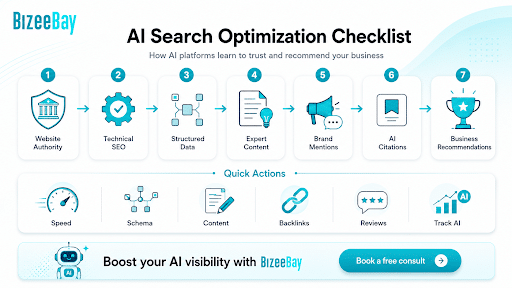
AI platforms look for clear and reliable information. They may consider your website content, reviews, backlinks, business listings, schema markup, and brand mentions.
A strong, large language model optimization guide should include four main areas.
1. Website Clarity
Your website should clearly explain what your business does. AI tools need simple and direct information to understand your services.
Your website should answer:
- Who do you help?
- What services do you provide?
- Where do you serve customers?
- Why should people trust you?
- What results can you deliver?
When this information is missing or confusing, AI tools may not understand your business properly.
2. Content Authority
Helpful content is one of the strongest parts of AI search optimization. AI platforms prefer information that answers real questions with depth and clarity.
Your blog should cover topics your customers care about. For example, a company offering SEO and LLMO services should publish guides about SEO, AI visibility optimization, ChatGPT SEO, and content strategy.
This builds topical authority and improves your chance of appearing in AI-generated answers.
3. Structured Data
Structured data helps search engines and AI systems understand your website better. It gives clear context about your business, services, articles, reviews, and contact information.
Useful schema types include:
- Organization schema
- Local business schema
- Service schema
- Article schema
- FAQ schema
- Review schema
When the schema is added correctly, your website becomes easier to interpret. As a result, it can support both SEO and AI visibility optimization.
4. Brand Authority
AI systems often look beyond your website. They may consider whether other trusted websites mention your business.
Brand authority can come from:
- Customer reviews
- Business directories
- Guest articles
- Case studies
- Industry mentions
- Quality backlinks
- Social proof
The stronger your authority signals are, the more trustworthy your business appears.
How to Optimize a Website for AI Search
To optimize a website for AI search, start with clarity. Your pages should explain your services in simple, useful, and complete language.
Each important service page should include:
- A clear headline
- Service details
- Customer pain points
- Benefits and outcomes
- Proof of experience
- Frequently asked questions
- Internal links
- Contact options
Next, improve your blog content. Publish articles that answer specific questions business owners are asking. This helps both SEO and answer engine optimization.
For example, strong blog topics may include:
- What is LLMO?
- How does ChatGPT SEO work?
- How can businesses improve AI search visibility?
- What is generative engine optimization?
- How do AI platforms choose sources?
Finally, keep your business information consistent across your website, Google Business Profile, directories, and social channels. Consistency improves trust.
AI Search Optimization, GEO, and AEO
AI search optimization is the broad strategy of improving visibility across AI-powered search tools. It includes SEO, LLMO, content strategy, technical fixes, and authority building.
Generative engine optimization focuses on visibility inside AI-generated responses. It helps your brand become part of the answers created by tools like ChatGPT and Gemini.
Answer engine optimization focuses on creating clear answers for users and platforms. It supports featured snippets, voice search, AI answers, and direct response formats.
Although these terms are different, they work toward the same goal. They help your business become easier to find, understand, and trust.
When Should You Invest in LLMO Services?
You should consider LLMO services when your business wants better visibility across both search engines and AI platforms. This is especially important if customers compare providers before contacting you.
An experienced LLMO agency can help you understand how AI tools currently view your brand. They can also perform an AI visibility audit to find gaps in your website, content, and authority signals.
You may need expert support if:
- Your business does not appear in AI answers
- Your competitors are mentioned more often
- Your website content is unclear
- Your service pages are weak
- Your brand lacks trusted mentions
- Your team does not track AI citations
- You need a complete AI search strategy
Working with an AI SEO agency or generative engine optimization agency can help you move faster. It also gives your business a structured plan for long-term visibility.
How to Measure AI Search Visibility
Measuring LLMO requires more than checking keyword rankings. You also need to track how AI platforms mention your business.
Important metrics include:
|
Metric |
Why It Matters |
|
AI citations |
Shows whether AI tools reference your brand |
|
Brand mentions |
Measures authority across the web |
|
Organic traffic |
Shows SEO growth |
|
Keyword rankings |
Tracks search performance |
|
Review growth |
Builds trust signals |
|
Lead quality |
Shows business impact |
|
Content visibility |
Measures topic strength |
|
Conversion rate |
Tracks real results |
Regular tracking helps you understand what is working. It also shows where your LLMO strategy needs improvement.
The Future of LLMO for Business Owners
Large language model optimization will become more important as AI search grows. Customers want faster answers, clearer comparisons, and trusted recommendations.
Businesses that prepare now can build an early advantage. They can create better content, improve technical structure, and strengthen authority before competition becomes stronger.
However, LLMO should not replace SEO. Instead, it should work with SEO, content marketing, and website optimization.
The best strategy is simple. Build a helpful website, publish expert content, earn trust, and make your business easy for AI tools to understand.
Ready to Improve Your AI Search Visibility?
Your customers are no longer searching in only one place. They are using Google, ChatGPT, Gemini, Claude, Perplexity, and other AI tools to make decisions.
At BizeeBay, we help businesses improve visibility with SEO, LLMO services, AI search optimization services, ChatGPT SEO services, and AI search consulting. Our team can also run an AI visibility audit to show where your brand stands today.
Ready to make your business easier for AI tools to find and recommend?
Explore BizeeBay LLMO services: https://bizeebay.com/services/large-language-model-optimization/
Explore BizeeBay SEO services: https://bizeebay.com/services/bizeebay-seo/
Book your free consultation: https://bizeebay.com/contact-us/
Build smarter visibility today and let your business show up where modern customers are already searching.
Frequently Asked Questions
What is large language model optimization?
Large language model optimization is the process of improving your website, content, and authority signals so AI tools can understand and recommend your business.
What does LLMO mean?
LLMO means Large Language Model Optimization. It helps businesses improve visibility across AI platforms like ChatGPT, Gemini, Claude, and Perplexity.
Is LLMO different from SEO?
Yes. SEO focuses on search engine rankings, while LLMO focuses on AI answers, brand understanding, citations, and recommendations.
Why do businesses need LLMO?
Businesses need LLMO because customers now use AI tools to find services, compare providers, and ask for trusted recommendations.
How long does LLMO take to work?
LLMO can show early improvements within a few months, but stronger results usually need consistent content, authority building, and tracking.