
Launching a Shopify store is relatively straightforward.
Getting the right customers to find it through Google can be much harder.
You may have excellent products, professional photography, competitive pricing, and a beautifully designed store. But if search engines can’t properly discover, understand, and rank your pages, potential customers may never find them.
That’s where Shopify SEO comes in.
Shopify SEO is the process of optimizing a Shopify store to improve its visibility in organic search results. It combines keyword research, product and collection optimization, technical SEO, content creation, internal linking, structured data, website performance, and authority building.
Shopify provides several useful SEO features out of the box, including automatically generated canonical tags, sitemap.xml and robots.txt files, and editable titles, descriptions, URLs, and image alt text. But those features don’t eliminate the need for an SEO strategy.
In this guide, we’ll explain how to optimize your Shopify store for SEO and build a stronger foundation for sustainable organic growth.
What Is Shopify SEO?
Shopify SEO is search engine optimization specifically applied to websites built on the Shopify ecommerce platform.
The objective is to help search engines understand your products, collections, content, and overall website while making it easier for shoppers to find what they’re looking for.
Shopify SEO typically covers three major areas:
On-page SEO focuses on keywords, titles, descriptions, headings, product content, collection content, images, and internal links.
Technical SEO focuses on crawlability, indexing, site architecture, canonicalization, structured data, mobile usability, performance, and other technical elements.
Off-page SEO focuses primarily on building your brand’s authority and earning relevant links and mentions from other websites.
Successful ecommerce SEO requires all three.
Why Is SEO Important for Shopify Stores?
Paid advertising can put your products in front of customers quickly, but traffic generally depends on continued spending.
SEO works differently.
Strong product, collection, and informational pages can continue attracting relevant organic searches over time.
For example, an online furniture store might want visibility for searches such as:
- solid wood dining tables
- modern office desks
- walnut coffee tables
- how to choose a dining table
- best desk size for a home office
Some searches demonstrate immediate purchasing intent. Others show customers researching before deciding.
A good Shopify SEO strategy targets customers throughout that journey.
Google also provides multiple surfaces where ecommerce products may appear, including standard Search results, Google Images, and Google Lens.
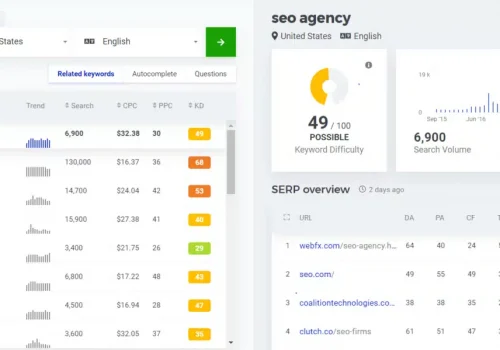
1. Start With Shopify Keyword Research
Every successful Shopify SEO strategy should begin with understanding what your potential customers actually search for.
Don’t optimize product pages around terminology only your company uses.
Optimize them around the language customers use.
Suppose your store sells leather bags.
A broad keyword could be:
leather bags
More specific searches might include:
women’s leather crossbody bag
brown leather laptop bag
full-grain leather messenger bag
leather work bag for women
The more specific search can sometimes reveal much stronger purchase intent.
Match Keywords to the Right Pages
Don’t try to rank every keyword with your homepage.
Map different search intentions to appropriate pages.
For example:
Search | Best Page Type |
men’s running shoes | Collection |
black waterproof running shoe | Product |
how to choose running shoes | Blog |
running shoes for flat feet | Collection/Guide |
Brand name | Homepage |
This approach helps prevent several pages from unnecessarily competing for the same search intent.
2. Optimize Shopify Product Pages
Product pages are among the most commercially valuable pages on an ecommerce website.
Yet many stores simply upload the manufacturer’s product description and move on.
That’s a missed SEO opportunity.
A strong Shopify product page should clearly communicate:
- What the product is
- Who it’s for
- Key benefits
- Important features
- Materials or specifications
- Sizes or dimensions
- Relevant use cases
- Shipping information where appropriate
- Returns information where appropriate
- Genuine customer reviews when available
Write for shoppers first.
Then make sure relevant search terms appear naturally where they help describe the product.
3. Optimize Shopify Product Titles
Your product title should be specific enough for both customers and search engines to understand what you’re selling.
Instead of:
The Parker
Consider:
Parker Women’s Black Leather Crossbody Bag
when that accurately describes the product.
Avoid turning titles into keyword lists.
Shopify recommends unique, descriptive page titles and advises placing important target keywords toward the beginning where appropriate.
4. Write Unique Product Descriptions
Copying manufacturer descriptions across hundreds of stores gives search engines little reason to view your version as uniquely valuable.
Create original product descriptions where possible.
Don’t just describe specifications.
Explain why those specifications matter.
Instead of:
100% waterproof exterior.
You could explain:
The waterproof exterior helps protect your belongings during commutes, travel, and unexpected rain.
The second version communicates a customer benefit while still providing useful product information.
Unique descriptions also give you more opportunities to naturally address long-tail searches.
5. Optimize Shopify Collection Pages
Collection pages are often overlooked.
They shouldn’t be.
For broad commercial searches such as men’s running shoes, organic skincare, or modern office furniture, a collection page may be more appropriate than an individual product.
Optimize collection pages with:
- Descriptive titles
- Clear H1 headings
- Useful introductory copy
- Relevant products
- Logical filtering
- Internal links
- Helpful supporting content where appropriate
Don’t add 1,000 words of generic SEO copy above your products simply because someone told you longer pages rank better.
Give customers useful context without making them scroll through an essay before they can shop.
6. Optimize Title Tags and Meta Descriptions
Shopify allows merchants to customize SEO titles and meta descriptions for pages, products, collections, and blog content.
A product title might be:
Women’s Leather Crossbody Bag | Brand Name
And the meta description could explain the product’s main benefit, distinguishing feature, and relevant buying information.
Meta descriptions aren’t a place to dump keywords.
Think of them as search-result copy designed to help qualified searchers understand why your page may answer their need.
7. Build a Search-Friendly Shopify Site Structure
Your store architecture matters.
A simple structure might look like:
Homepage → Collection → Subcategory → Product
Google recommends creating crawlable navigation that links from menus to categories, categories to subcategories, and ultimately to product pages. Google also notes that products accessible only through an internal search box may not be discovered through normal crawling.
Keep important products reasonably easy to reach.
Your best-selling or strategically important products can also receive contextual internal links from blog posts, buying guides, and other relevant pages.
8. Improve Shopify Internal Linking
Internal links help customers navigate your store and help search engines understand relationships between pages.
Useful ecommerce internal links can connect:
Blog → Collection
Blog → Product
Collection → Product
Product → Related Product
Homepage → Important Collection
Buying Guide → Relevant Products
Use descriptive anchor text where it feels natural.
Instead of:
Click here
use something informative such as:
shop women’s waterproof running shoes
when that’s genuinely the destination.
Google specifically recommends meaningful anchor text for ecommerce links.
9. Optimize Your Shopify URLs
Keep URLs readable and descriptive.
A clear product URL is easier for people and search engines to interpret than a confusing URL filled with unnecessary parameters.
More importantly, manage duplicate and variant URLs carefully.
Google recommends self-referencing canonicals on indexable ecommerce pages and appropriate canonical handling where product variants have unique URLs.
This becomes particularly important on stores with:
- Product variants
- Filters
- Sorting
- Faceted navigation
- Tracking parameters
- Multiple collection paths
Don’t change established URLs solely to insert an extra keyword. Changing indexed URLs unnecessarily can create more SEO work than value.
10. Optimize Shopify Images
Images are essential to ecommerce.
But huge, poorly optimized images can affect performance.
Optimize product imagery by:
- Compressing images appropriately
- Choosing sensible dimensions
- Using descriptive filenames
- Adding useful alt text
- Avoiding keyword-stuffed alt attributes
- Providing high-quality original product images where possible
Alt text should primarily describe the image for accessibility.
For example:
Black leather crossbody bag with adjustable shoulder strap
is more useful than:
best leather bag leather handbag buy leather purse online
The second example is keyword stuffing, not optimization.
11. Implement Product Structured Data
Product structured data can help Google better understand product information such as price, availability, ratings, shipping information, and other details.
Eligible product pages may receive richer presentations across Google Search experiences.
Depending on your store, relevant structured data can include:
- Product
- Offer
- ProductGroup
- BreadcrumbList
- Organization
- Review
For products with variants such as different colors or sizes, Google supports ProductGroup and related product-variant structured data.
But don’t add fake ratings, reviews, prices, or availability just to obtain rich results.
Structured data must accurately represent what’s actually on the page.
12. Connect Your Store to Google Merchant Center
SEO shouldn’t stop at traditional blue-link results.
Google recommends providing ecommerce product data through both structured data on your website and a Google Merchant Center feed where feasible. Using both can maximize eligibility for relevant Google shopping experiences and help Google verify product information.
Keep important product information accurate, including:
- Product titles
- Prices
- Availability
- Images
- Brand information
- Product identifiers
- Shipping information
- Returns information
This creates a stronger product-data foundation across Google’s commerce ecosystem.
13. Improve Shopify Website Speed
Website performance affects both customer experience and SEO.
A Shopify store can become unnecessarily heavy after installing numerous apps, tracking scripts, oversized images, custom features, and elaborate theme elements.
Regularly review:
- Image sizes
- Third-party apps
- Tracking scripts
- Theme code
- Unnecessary JavaScript
- Font usage
- Core Web Vitals
- Mobile performance
Don’t optimize a website for a perfect speed-test score at the expense of features customers actually need.
The goal is a fast, functional shopping experience.
14. Handle Faceted Navigation Carefully
Filters are valuable for shoppers.
A clothing store might let customers filter by:
Size → Color → Brand → Price → Material
But filters can potentially create huge numbers of URL combinations.
For a large store, uncontrolled faceted navigation can make crawling inefficient and generate low-value or duplicate URLs.
Google provides specific guidance for managing crawling of faceted navigation as part of ecommerce SEO. Its broader ecommerce URL guidance also recommends avoiding indexing pages without useful content.
This is an area where professional technical Shopify SEO can be especially valuable.
15. Create Content Beyond Product Pages
A Shopify blog isn’t just for company announcements.
Use content to capture searches customers make before purchasing.
For example, a skincare store could publish:
How to Build a Skincare Routine for Dry Skin
Vitamin C vs. Niacinamide: What’s the Difference?
How Often Should You Exfoliate Your Skin?
How to Choose a Moisturizer for Sensitive Skin
These articles can attract informational searches and naturally direct interested visitors toward relevant collections and products.
Focus on helping customers make better decisions—not manufacturing blog posts purely to target keywords.
16. Build High-Quality Backlinks and Brand Authority
On-page optimization alone isn’t the entire SEO equation.
Relevant links and mentions can help build authority around your brand and products.
Potential strategies include:
- Digital PR
- Original research
- Useful industry resources
- Product features
- Supplier partnerships
- Expert contributions
- Relevant publications
- Genuine product reviews
- Partnerships
- Link-worthy guides
Avoid buying large volumes of low-quality backlinks.
Sustainable SEO focuses on building a brand and resources worth referencing.
17. Optimize Shopify for Mobile Shoppers
Your ecommerce experience needs to work exceptionally well on smartphones.
Review:
- Navigation
- Product images
- Buttons
- Variant selection
- Filters
- Search
- Forms
- Cart
- Checkout
- Font readability
- Page speed
Don’t evaluate your store only from a desktop computer.
A product page that looks beautiful on a large monitor but is frustrating on a phone can cost both traffic and sales.
18. Monitor Shopify SEO Performance
SEO isn’t a one-time setup.
Track performance using tools such as Google Search Console and your analytics platform.
Pay attention to:
- Organic clicks
- Search impressions
- Search queries
- Average search positions
- Indexed pages
- Crawling issues
- Product rich-result errors
- Organic revenue
- Conversion rates
- Landing-page performance
Google Search Console also provides reports for merchant listings and product snippets, which can help identify structured-data issues affecting ecommerce pages.
Traffic alone isn’t enough.
For an ecommerce business, the ultimate objective is attracting qualified visitors who become customers.
Common Shopify SEO Mistakes to Avoid
Even well-designed Shopify stores can suffer from preventable SEO problems.
Watch for:
- Duplicate manufacturer product descriptions
- Thin collection pages
- Keyword stuffing
- Missing internal links
- Poor site architecture
- Unoptimized product titles
- Low-quality blog content
- Broken links
- Incorrect canonicalization
- Uncontrolled faceted URLs
- Oversized images
- Too many unnecessary apps
- Invalid product schema
- Products that aren’t easily crawlable
- Ignoring Google Search Console
- Building spammy backlinks
One of the biggest mistakes is assuming Shopify automatically handles everything related to SEO.
The platform provides a solid technical starting point, but competitive organic growth still requires strategy.
Shopify SEO Checklist
Before considering your Shopify store properly optimized, check that you have:
- Completed keyword research
- Mapped keywords to appropriate pages
- Optimized product titles
- Written original product descriptions
- Optimized important collection pages
- Created useful title tags and meta descriptions
- Built logical site navigation
- Added contextual internal links
- Optimized product images
- Reviewed canonical URLs
- Checked crawlability and indexing
- Implemented valid product structured data
- Configured Google Merchant Center where appropriate
- Reviewed website speed and Core Web Vitals
- Checked mobile usability
- Developed an ongoing content strategy
- Built legitimate authority and backlinks
- Set up Google Search Console
- Tracked organic conversions and revenue
Does Shopify Have Good SEO?
Yes.
Shopify can support highly visible ecommerce websites. It automatically handles several technical elements and gives merchants control over important on-page SEO fields.
However, the platform can’t automatically determine:
Which keywords your customers use.
What content will best satisfy their intent.
How your products should be organized.
Which collections deserve priority.
How to build authority in your market.
Which technical issues are holding back your particular store.
That’s where an actual SEO strategy becomes important.
Grow Your Shopify Store With a Smarter SEO Strategy
Successful Shopify SEO isn’t about inserting keywords into hundreds of product descriptions and hoping Google ranks them.
It’s about building an ecommerce website that is easy to crawl, easy to understand, genuinely useful to shoppers, technically sound, and authoritative within its market.
That means combining:
Keyword research + product optimization + collection optimization + technical SEO + structured data + content + internal linking + authority + performance.
BizeeBay’s SEO services already cover technical SEO, on-page optimization, keyword research, content strategy, authority building, Core Web Vitals, crawl and index optimization, schema markup, internal linking, mobile optimization, and performance tracking.
For a Shopify store, those disciplines can work together to increase qualified organic visibility while supporting the larger goal: turning search traffic into customers.
Want to improve your Shopify store’s search visibility? Explore BizeeBay’s SEO services and build an e-commerce SEO strategy around your products, customers, and long-term growth.
Frequently Asked Questions
What is Shopify SEO?
Shopify SEO is the process of improving a Shopify store’s organic search visibility through keyword research, product and collection optimization, technical SEO, content, internal linking, structured data, website performance, and authority building.
Is Shopify good for SEO?
Yes. Shopify provides built-in SEO functionality such as canonical tags, sitemaps, robots.txt handling, editable titles and descriptions, and image alt text. Competitive stores still need ongoing optimization and a content strategy.
How do I rank my Shopify store on Google?
Start with keyword research, optimize products and collections for relevant search intent, improve site architecture and internal links, ensure important pages are crawlable and indexable, implement appropriate structured data, create useful content, improve performance, and build legitimate authority.
How long does Shopify SEO take?
There isn’t a universal timeframe. Results depend on factors such as the competitiveness of your market, the current condition and age of your site, technical issues, content quality, authority, and the amount of optimization required. Be cautious of anyone guaranteeing specific rankings within a fixed period.
Do Shopify product descriptions affect SEO?
Product descriptions give search engines and customers additional information about what a product is and why it’s useful. Original, informative descriptions can also help pages address relevant searches more effectively than generic manufacturer copy.